

DNA Synthesis Market to Reach US$8.3 Bn by 2033 at 12.3% CAGR | Persistence Market Research
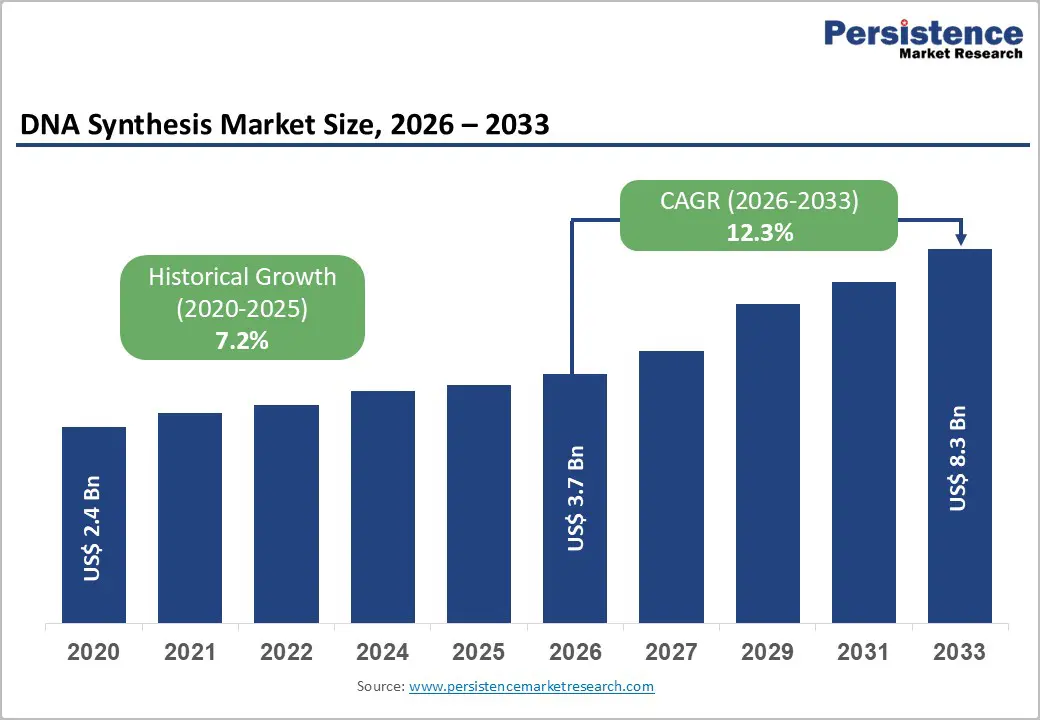
DNA synthesis market
DNA synthesis market driven by CRISPR advances, personalized medicine, and growing demand for high-precision genetic research and therapeutics development
LONDON, UNITED KINGDOM, April 8, 2026 /EINPresswire.com/ -- The global DNA synthesis market is projected to reach a value of US$ 3.7 billion in 2026 and is expected to grow to US$ 8.3 billion by 2033, registering a compound annual growth rate (CAGR) of 12.3% during the forecast period. This growth is not merely driven by incremental increases in research activity but by structural shifts in biotechnology, particularly the transition of gene editing technologies into clinical and commercial applications. One of the most significant catalysts has been the clinical validation of CRISPR-based therapeutics, which has created sustained demand for high-precision synthetic DNA components used in therapeutic development and manufacturing.
Download Your Free Sample & Explore Key Insights: https://www.persistencemarketresearch.com/samples/33942
Market Dynamics
A major driver of the DNA synthesis market is the advancement of CRISPR therapeutics from experimental stages to regulated clinical use. As genome editing technologies gain regulatory approvals and expand across therapeutic areas such as oncology, rare diseases, and genetic disorders, the need for synthetic DNA increases significantly. Each phase of CRISPR development, including guide RNA design, donor DNA synthesis, and validation, relies on precise and high-quality DNA constructs. This shift toward clinical applications is creating long-term and stable demand for DNA synthesis services, particularly for complex and customized sequences.
However, the market faces notable challenges. Manufacturing complexity remains a key restraint, especially for therapeutic-grade DNA synthesis. Traditional phosphoramidite chemistry experiences reduced efficiency with longer sequences, increasing costs and lowering yields. Additionally, stringent Good Manufacturing Practice (GMP) requirements necessitate high capital investment in infrastructure, advanced quality control systems, and analytical technologies. These factors create barriers for smaller companies and contribute to market consolidation. Quality consistency issues and intellectual property fragmentation further complicate large-scale production and technology adoption.
Supply chain vulnerabilities also present challenges. The market depends heavily on geographically concentrated suppliers for critical reagents and equipment. Trade tensions and regulatory differences across regions create uncertainties that hinder global expansion and technology transfer. Limited availability of specialized materials and regulatory harmonization gaps add to operational complexity and cost pressures.
Opportunities in Personalized Medicine
Personalized medicine represents a significant growth opportunity within the DNA synthesis market. Advances in next-generation sequencing and synthetic biology are enabling the development of patient-specific therapies based on individual genetic profiles. This has led to the emergence of premium service models where customized DNA constructs are developed for targeted treatments. Personalized CRISPR therapies, tailored to specific genetic mutations, are expanding clinical applications and creating new revenue streams.
Additionally, applications in tissue engineering, regenerative medicine, and companion diagnostics are driving demand for specialized DNA synthesis solutions. Companies that can integrate genomic analysis, synthesis, and therapeutic development into a unified workflow are likely to gain a competitive advantage through enhanced customer retention and data-driven innovation.
Get Custom Insights Designed for Your Businecss: https://www.persistencemarketresearch.com/request-customization/33942
Category-wise Analysis
In terms of product segments, oligonucleotides held the largest market share of 27% in 2025. Their widespread use in molecular biology, diagnostics, and therapeutics supports consistent demand. PCR primers, a key sub-segment, remain essential tools in research and clinical laboratories worldwide. Advances in purification and synthesis technologies have further strengthened their role in therapeutic applications.
Gene synthesis, however, is emerging as the fastest-growing segment, driven by increasing demand for complex genetic constructs in gene therapy and synthetic biology. Innovations in enzymatic synthesis and array-based technologies are reducing costs and enabling the production of longer DNA sequences. As pricing continues to decline, gene synthesis is expected to expand into large-scale and personalized applications that were previously cost-prohibitive.
End-User Insights
Biopharmaceutical companies dominate the end-user segment due to their extensive research and development activities in drug discovery and gene therapy. Many large firms are adopting vertical integration strategies to secure supply chains and improve margins. Academic and research institutions also contribute significantly, supported by government funding and large-scale genomics initiatives. Meanwhile, clinical laboratories are emerging as a growing segment, particularly with the rise of genetic testing and personalized medicine in healthcare systems.
Regional Insights
North America leads the DNA synthesis market, supported by advanced research infrastructure, strong funding, and early adoption of emerging technologies. The region benefits from a well-established ecosystem that facilitates rapid translation from research to commercialization. High demand for synthetic DNA in therapeutics, diagnostics, and vaccine development continues to reinforce its dominant position.
Asia Pacific is the fastest-growing region, driven by increasing investments in biotechnology, expanding research capabilities, and cost-efficient manufacturing. Government initiatives promoting genomics and precision medicine, along with the growth of contract research organizations and biotech startups, are accelerating market expansion. The region is gradually transitioning from a cost-focused manufacturing base to a strategic hub for innovation and growth.
Checkout Now & Download Complete Market Report: https://www.persistencemarketresearch.com/checkout/33942
Competitive Landscape
The DNA synthesis market is highly competitive and innovation-driven. Companies compete on parameters such as accuracy, turnaround time, scalability, and the ability to deliver complex DNA constructs. Strategic collaborations, partnerships, and capacity expansions are common as firms aim to strengthen their market presence. Technological advancements in automation, error reduction, and regulatory compliance are becoming key differentiators, particularly in therapeutic applications where precision and quality are critical.
Market Segmentation
By Product
Oligonucleotides (short DNA sequences)
Gene synthesis (custom genes)
DNA libraries
Reagents & kits
Instruments & synthesizers
By Application
Research & Development (R&D)
Diagnostics
Therapeutics
Academic use
Industrial use
By End-user
Biotech & pharma companies
Academic & research institutes
Contract research organizations (CROs)
Clinical laboratories
By Region
North America
Europe
Asia Pacific
Latin America
Middle East & Africa
Read Related Reports:
Humanized Liver Mice Model Market: Humanized Liver Mice Model Market to reach US$169.4 Mn by 2033 at 5.6% CAGR, driven by human-relevant preclinical testing and liver disease research.
Pharmacy Benefit Manager Market: The global pharmacy benefit manager market is set to grow at a 6.5% CAGR through 2033, driven by chronic diseases, specialty drugs, and value-based care.
Persistence Market Research
Persistence Market Research Pvt Ltd
+1 646-878-6329
email us here
Visit us on social media:
LinkedIn
Instagram
Facebook
YouTube
X
Legal Disclaimer:
EIN Presswire provides this news content "as is" without warranty of any kind. We do not accept any responsibility or liability for the accuracy, content, images, videos, licenses, completeness, legality, or reliability of the information contained in this article. If you have any complaints or copyright issues related to this article, kindly contact the author above.
