

Genetically Modified Food Market Forecast 2026-2036: Market to Reach USD 269 Billion by 2036
Genetically Modified Food Market
Key industry participants include: Bayer AG, Corteva, Inc., Syngenta Group Co., Ltd., BASF SE, Inari Agriculture, Inc., Tropic Biosciences UK Limited,
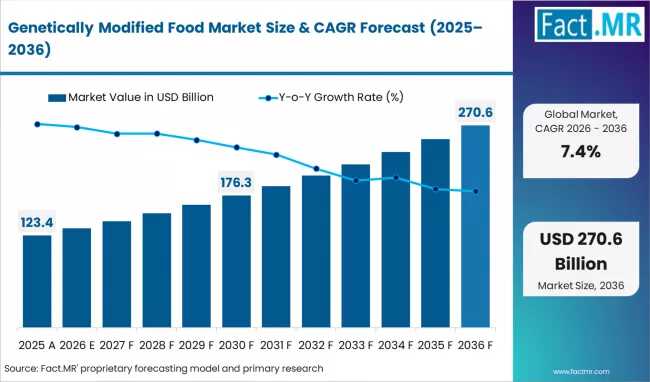
ROCKVILLE, MD, UNITED STATES, March 17, 2026 /EINPresswire.com/ -- The global agricultural landscape is undergoing a calculated evolution. As food systems grapple with the dual pressures of climate volatility and rising caloric demand, the genetically modified (GM) food market has solidified its role as a critical pillar of industrial food security.According to the latest strategic analysis by Fact.MR, the global genetically modified food market is valued at USD 132.5 billion in 2026. Projections indicate a steady ascent to USD 269.6 billion by 2036, representing a compound annual growth rate (CAGR) of 7.4%. This expansion reflects an absolute dollar growth of USD 137.1 billion over the next decade, driven not by a radical shift in diet, but by the deep integration of biotechnology into existing grain and oilseed supply chains.
Get Access Report Sample https://www.factmr.com/connectus/sample?flag=S&rep_id=14571
The Efficiency Engine: Drivers of Market Expansion
The momentum behind GM adoption is rooted in the pragmatic needs of large-scale commercial farming. Modern agricultural systems increasingly rely on ""Yield Stability"" as a hedge against environmental stressors.
Livestock Dominance: The animal feed sector currently commands approximately 65% of the market share. As global demand for protein—specifically poultry, cattle, and aquaculture—intensifies, the need for high-protein, cost-efficient feed like GM soybean and corn remains non-negotiable.
Trait Specialization: Beyond simple pest resistance, the market is seeing a shift toward ""stacked traits""—seeds that offer simultaneous herbicide tolerance and insect resistance, streamlining farm management and reducing chemical overhead.
Processing Reliability: Food manufacturers and edible oil producers prioritize the consistent raw material flow that GM crops provide, particularly in the soybean segment, which accounts for 45% of the total market value.
Emerging Trends: Beyond Traditional Modification
While the first generation of GM crops focused on farmer-centric traits, the next decade is defined by structural sophistication. The rise of gene-edited crops and trait-specific varieties is creating a higher-value tier within the market.
Industry leaders are shifting focus toward environmental resilience—developing seeds capable of maintaining yields in water-stressed or high-salinity soil. Furthermore, while regulatory scrutiny remains high in regions like Western Europe, the ""U.S. National Bioengineered Food Disclosure Standard"" and similar frameworks globally are providing the legal clarity necessary for long-term institutional investment.
Regional Powerhouses: Latin America and South Asia Lead Growth
Geographic analysis reveals a significant tilt toward export-oriented economies and developing agricultural giants:
Brazil (6.3% CAGR): Leading the global pack, Brazil’s growth is fueled by aggressive expansion in GM soybean and corn cultivation, supported by the National Biosafety Technical Commission’s proactive approval cycles.
India (6.1% CAGR): As food security remains a top national priority, India is gradually integrating biotech solutions into selected agricultural segments to bolster domestic productivity.
United States (5.8% CAGR): A mature yet dominant market, the U.S. remains the epicenter of biotechnology R&D, with stable demand from its massive processed food and ethanol industries.
Argentina (5.9% CAGR): Its established export-oriented model ensures that GM soybean production remains the backbone of its agricultural economy.
Competitive Landscape: A Moderately Concentrated Market
The GM food sector is characterized by high entry barriers due to intensive R&D requirements and complex regulatory pathways. A core group of global giants currently shapes the market's trajectory through extensive intellectual property portfolios and integrated seed-and-protection models.
Key industry participants include: Bayer AG, Corteva, Inc., Syngenta Group Co., Ltd., BASF SE, Inari Agriculture, Inc., Tropic Biosciences UK Limited, Pairwise Plants, LLC, KWS SAAT SE & Co. KGaA, Groupe Limagrain, Origin Agritech Limited.
Emerging firms are increasingly focusing on niche gene-editing platforms (CRISPR), which may bypass some of the traditional ""GMO"" stigmas and offer more targeted crop improvements.
Analyst Outlook: Strategic Stability
""The genetically modified food market remains fundamentally tethered to the scale of global agricultural production,"" says Shambhu Nath Jha, Principal Consultant at Fact.MR. ""We are seeing a market that is maturing from a 'novel technology' phase into a 'critical infrastructure' phase. Companies that successfully navigate the intersection of advanced seed genetics and local regulatory compliance will be the ones to capture the USD 137 billion in value created over the next ten years.""
Future Opportunities for Stakeholders
The transition toward 2036 offers distinct opportunities for investors and decision-makers:
Seed Genetics Platforms: Investing in varieties that address localized environmental shifts.
Regulatory Compliance Tech: Strengthening documentation and labeling capabilities to meet evolving consumer transparency demands.
Distribution Networks: Expanding seed supply chains in high-growth regions like Brazil and India.
To View Related Report
Modified Starch Market https://www.factmr.com/report/modified-starch-market
Modified Wheat Starch Market https://www.factmr.com/report/modified-wheat-starch-market
Food Stabilizers Market https://www.factmr.com/report/food-stabilizers-market
Food Grade Post Harvest Decay Control Coating Market https://www.factmr.com/report/food-grade-post-harvest-decay-control-coating-market
Food Cold Chain Market https://www.factmr.com/report/food-cold-chain-market
S. N. Jha
Fact.MR
+1 628-251-1583
email us here
Legal Disclaimer:
EIN Presswire provides this news content "as is" without warranty of any kind. We do not accept any responsibility or liability for the accuracy, content, images, videos, licenses, completeness, legality, or reliability of the information contained in this article. If you have any complaints or copyright issues related to this article, kindly contact the author above.
