

NB-IoT Chipset Market to Reach US$5.3 Bn by 2033 Driven by Smart Grid, IoT, and Automotive Growth
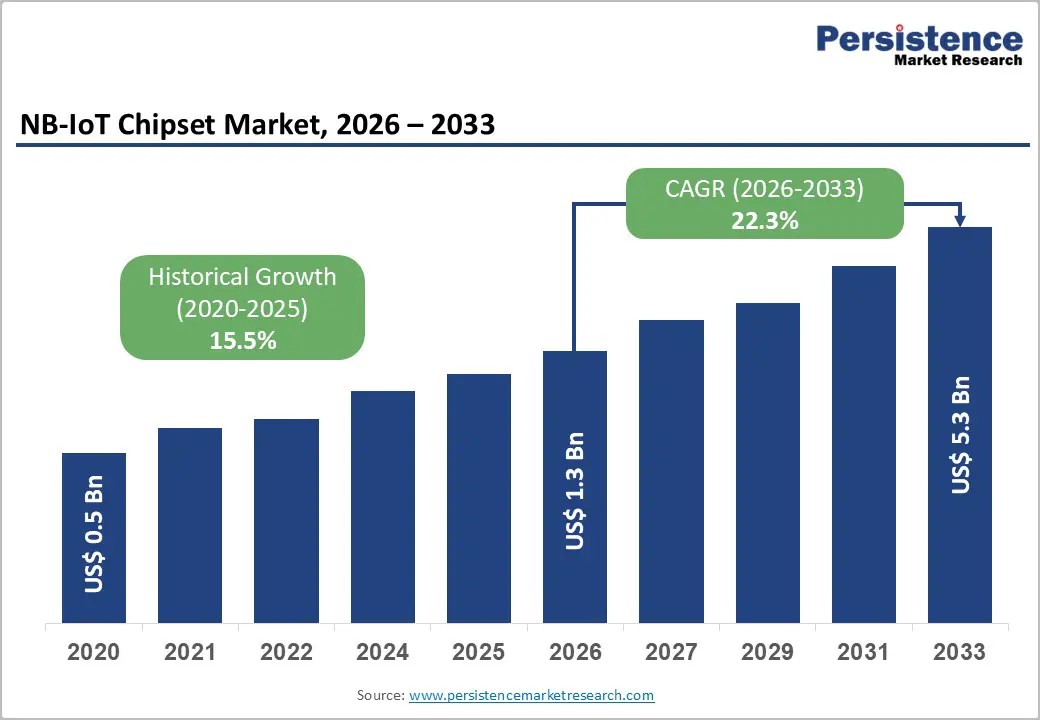
The global NB-IoT chipset market will grow from US$1.3 Bn in 2026 to US$5.3 Bn by 2033 at a 22.3% CAGR, driven by power-efficient cellular IoT
BRENTFORD, ENGLAND, UNITED KINGDOM, March 16, 2026 /EINPresswire.com/ -- The global NB-IoT chipset market is entering a transformative phase as industries accelerate the adoption of low-power wide-area connectivity solutions. According to recent market projections, the NB-IoT chipset market is expected to grow from US$ 1.3 billion in 2026 to US$ 5.3 billion by 2033, expanding at a robust CAGR of 22.3% during the forecast period.
This rapid growth reflects the increasing demand for energy-efficient, standardized, and scalable connectivity solutions across smart infrastructure, utilities, transportation, and industrial IoT ecosystems. NB-IoT technology is becoming a preferred communication platform for connected devices due to its ability to provide long battery life, deep indoor coverage, and cost-effective connectivity.
The adoption of NB-IoT chipsets is particularly accelerating in applications such as smart metering, environmental monitoring, asset tracking, smart cities, and connected vehicles. Governments and enterprises worldwide are investing heavily in digital infrastructure and IoT deployments, creating strong momentum for the market.
𝐆𝐞𝐭 𝐚 𝐒𝐚𝐦𝐩𝐥𝐞 𝐏𝐃𝐅 𝐁𝐫𝐨𝐜𝐡𝐮𝐫𝐞 𝐨𝐟 𝐭𝐡𝐞 𝐑𝐞𝐩𝐨𝐫𝐭: https://www.persistencemarketresearch.com/samples/27283
Growing Demand for IoT Connectivity Driving Market Expansion
The Internet of Things ecosystem is expanding rapidly across industries, creating unprecedented demand for low-power and long-range connectivity solutions. NB-IoT technology addresses this need by enabling devices to operate efficiently on minimal power while transmitting small data packets over cellular networks.
Unlike traditional wireless technologies, NB-IoT is specifically designed for massive machine-type communications (mMTC). It enables millions of devices to connect to a single network with minimal energy consumption and reduced operational costs.
Industries such as utilities, transportation, agriculture, and healthcare are deploying connected sensors and monitoring systems at scale. These deployments require reliable connectivity solutions capable of operating for years without battery replacement.
As a result, NB-IoT chipsets have become essential components for enabling large-scale IoT networks worldwide.
Standardization and Battery Efficiency Transforming Device Ecosystems
Another key factor driving the growth of the NB-IoT chipset market is the global standardization of NB-IoT technology through the 3rd Generation Partnership Project (3GPP).
The introduction of the NB-IoT standard in 3GPP Release 13 established a unified communication framework that allows devices from different manufacturers to operate seamlessly across global cellular networks.
This standardization has accelerated adoption by reducing compatibility concerns and enabling telecom operators to deploy NB-IoT services on existing LTE infrastructure.
At the same time, chipset manufacturers have achieved remarkable improvements in energy efficiency.
Modern NB-IoT chipsets enable devices to operate for 10 to 15 years on a single battery, making them ideal for remote monitoring applications such as:
Environmental sensors
Water meters
Agricultural monitoring systems
Industrial asset tracking
For instance, advanced IoT modems introduced by semiconductor companies have demonstrated up to 70% power savings in idle mode, significantly extending device lifespan.
These technological advancements are expanding the potential applications for NB-IoT connectivity across industries.
𝐃𝐨 𝐘𝐨𝐮 𝐇𝐚𝐯𝐞 𝐀𝐧𝐲 𝐐𝐮𝐞𝐫𝐲 𝐎𝐫 𝐒𝐩𝐞𝐜𝐢𝐟𝐢𝐜 𝐑𝐞𝐪𝐮𝐢𝐫𝐞𝐦𝐞𝐧𝐭? 𝐑𝐞𝐪𝐮𝐞𝐬𝐭 𝐂𝐮𝐬𝐭𝐨𝐦𝐢𝐳𝐚𝐭𝐢𝐨𝐧 𝐨𝐟 𝐑𝐞𝐩𝐨𝐫𝐭: https://www.persistencemarketresearch.com/request-customization/27283
Key advantages include:
Reduced manufacturing cost
Smaller device footprint
Improved energy efficiency
Faster product development
These benefits make standalone chipsets ideal for large-scale IoT deployments such as smart meters and tracking devices.
Energy Sector Dominates End-Use Demand
The energy sector remains the largest consumer of NB-IoT chipsets, accounting for approximately 24% of global demand.
Utilities are increasingly adopting IoT technologies to improve grid efficiency, reduce operational costs, and integrate renewable energy sources.
Key applications include:
Smart electricity meters
Gas and water metering
Grid monitoring sensors
Renewable energy asset tracking
The growing complexity of energy networks requires real-time monitoring and analytics, which can only be achieved through connected infrastructure.
Regional Market Insights
North America Leading Global Market
North America holds the largest share of the NB-IoT chipset market at approximately 32%.
The region’s leadership is driven by:
Advanced telecommunications infrastructure
Early adoption of IoT technologies
Government support for smart grid development
Growing EV charging infrastructure
Telecom operators in the United States have deployed nationwide NB-IoT networks to support large-scale IoT deployments.
East Asia Driving High-Volume Growth
East Asia represents the largest volume market for NB-IoT chipsets due to massive smart infrastructure projects.
China is the dominant contributor to regional demand, supported by:
Large-scale smart meter programs
Renewable energy expansion
Industrial IoT adoption
Smart city initiatives
Japan and South Korea are also major adopters of NB-IoT technology for smart utilities and urban infrastructure.
Europe Strengthening IoT Infrastructure
Europe accounts for around 24% of the global market.
The region’s growth is driven by strict regulatory policies related to:
Smart energy management
Data privacy and cybersecurity
Environmental sustainability
European countries have implemented mandatory smart metering programs to support energy efficiency and carbon reduction goals.
𝐁𝐮𝐲 𝐍𝐨𝐰 𝐭𝐡𝐞 𝐃𝐞𝐭𝐚𝐢𝐥𝐞𝐝 𝐑𝐞𝐩𝐨𝐫𝐭: https://www.persistencemarketresearch.com/checkout/27283
Competitive Landscape
The global NB-IoT chipset market is moderately consolidated, with a few leading semiconductor companies dominating the industry.
Key players focus on low-power design, integrated security, and multi-mode connectivity to maintain competitive advantage.
Major companies operating in the market include:
Qualcomm Technologies
MediaTek Inc.
Huawei (HiSilicon / Huawei IoT)
Sequans Communications
Nordic Semiconductor
Sony Semiconductor Solutions (Altair Semiconductor)
u‑blox
STMicroelectronics
These companies invest heavily in research and development to improve power efficiency, connectivity performance, and security features.
Strategic partnerships with telecom operators, IoT platform providers, and device manufacturers are also critical for market expansion.
Future Outlook
The NB-IoT chipset market is poised for significant growth as global industries continue to adopt IoT technologies at scale. The increasing deployment of smart infrastructure, connected vehicles, and industrial IoT solutions will drive sustained demand for low-power connectivity.
Emerging technologies such as satellite-enabled IoT, 5G integration, and edge computing will further expand the potential applications of NB-IoT chipsets.
As governments and enterprises prioritize digital transformation and infrastructure modernization, NB-IoT technology will remain a foundational component of the global IoT ecosystem.
With strong growth prospects and expanding industry adoption, the NB-IoT chipset market is expected to play a central role in shaping the future of connected devices worldwide.
Related Reports:
Ad-Supported Video on Demand Market
Pooja Gawai
Persistence Market Research
+1 646-878-6329
email us here
Visit us on social media:
LinkedIn
Instagram
Facebook
YouTube
Legal Disclaimer:
EIN Presswire provides this news content "as is" without warranty of any kind. We do not accept any responsibility or liability for the accuracy, content, images, videos, licenses, completeness, legality, or reliability of the information contained in this article. If you have any complaints or copyright issues related to this article, kindly contact the author above.
